Utilizamos cookies para garantizar que le brindamos la mejor experiencia en nuestra web.
Manténgase al día con KCVENTS Soluciones de ventilación & HVAC
Suscríbase a nuestro boletín para recibir las últimas novedades sobre ingeniería del caudal de aire, actualizaciones de sistemas de recuperadores entálpicos y de calor (ERV/HRV) de alta eficiencia energética y soluciones de HVAC ecológicas.
Sea el primero en recibir guías técnicas exclusivas, información sobre capacidades personalizadas de OEM/ODM y novedades sobre ferias internacionales directamente de KCVENTS.
Activated Carbon Filter for Ventilation: How It Works, Sizing and Lifespan
Cómo funcionan los filtros de carbón activo, dónde utilizarlos en ventilación, cómo dimensionarlos y sustituirlos, y cuáles son sus límites, incluida la diferencia entre la filtración de carbón y la HEPA.
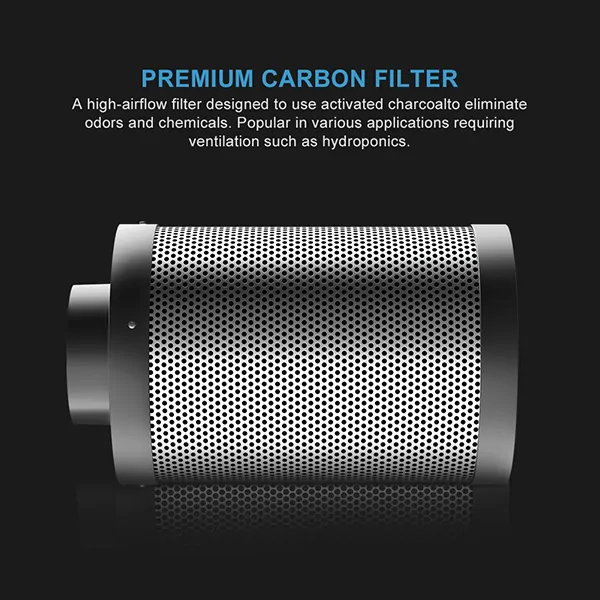
An activated carbon filter (also called an activated charcoal filter) removes odors, volatile organic compounds (VOCs) and certain airborne gases from ventilation air through physical adsorption—trapping gas molecules onto a vast internal network of microscopic carbon pores. Unlike a mechanical HEPA filter, an activated carbon filter does not capture dust or PM2.5 particles, cannot be washed and reused once saturated, and must be matched to duct airflow and contact time so odors do not blow straight through.
Por qué utilizar un filtro de carbón activo en ventilación
Particle filters (coarse pre-filters, MERV pleated filters and HEPA filters) trap solid droplets and dust, but gas molecules are orders of magnitude smaller and pass right through mechanical filter fibers. According to the U.S. EPA, research indicates that people spend approximately 90 percent of their time indoors, and studies have found that levels of several organic pollutants average 2 to 5 times higher indoors than outdoors (U.S. EPA, The Inside Story: A Guide to Indoor Air Quality). When a building needs to remove gaseous pollutants, VOCs or persistent odors from supply or exhaust air, the U.S. EPA Guide to Air Cleaners in the Home notes that gas-phase filtration—most commonly an activated carbon filter containing a substantial amount of carbon material—is required alongside source control and fresh-air exchange.
“Ventilation removes indoor air that may be concentrated with airborne viruses and replaces it with fresh outdoor air.”
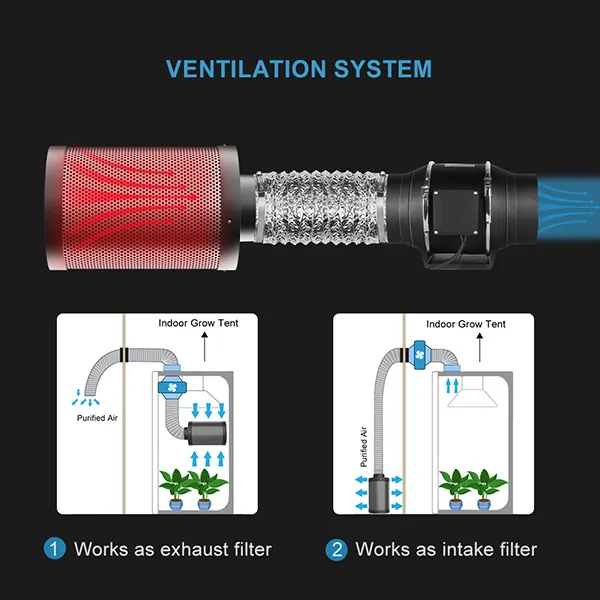
In ducted HVAC and exhaust systems, an activated carbon filter is always paired with a mechanical fan—such as an extractor en línea, cabinet fan or fresh-air ventilation unit—with enough static pressure to pull or push air steadily through both the particulate pre-filter and the carbon bed.
How Activated Carbon Filters Work (Adsorption, Residence Time & Breakthrough)
Activated carbon (produced by processing carbon-rich feedstocks such as coconut shell, coal or wood at high temperatures with steam or chemical agents) contains a dense network of micropores, mesopores and macropores that yields an enormous internal surface area—often exceeding 500 to 1,000 m² per gram (Activated carbon technical overview). Three physical principles decide whether an activated carbon air filter succeeds in the field:
Adsorption (Not Absorption): Gas and odor molecules adhere to the internal pore walls of the carbon via intermolecular van der Waals forces (or chemical bonding on impregnated carbon). Because active binding sites gradually fill up, adsorption capacity is finite and cannot be restored by household washing or vacuuming.
Residence Time (Contact Time): Air must remain inside the carbon bed long enough for gas molecules to diffuse into the micropores. Undersized filters or oversized fans push air too fast across the bed, slashing residence time and allowing odors to pass through untreated even when the carbon is brand new.
Mass Transfer Zone & Breakthrough: Adsorption starts at the inlet face of the carbon bed and gradually advances downstream as sites saturate. When that active zone reaches the outlet face, gas concentrations begin to climb on the clean side—the breakthrough point, signaling replacement is due.
Activated Carbon Filter vs HEPA Filter — Different Jobs, Complementary Stages
Criterio de comparación
Activated Carbon Filter
HEPA Filter
Target contaminants
Gases, odors and many VOCs (cooking smells, solvents, plant aromas, smoke gases)
Mechanical interception, impaction and diffusion in pleated fiber media
Standardized rating
No single universal consumer rating like MERV/HEPA; depends on carbon weight, bed depth, media type and residence time (U.S. EPA)
Captures at least 99.97% of 0.3 µm airborne particles under DOE/EPA definition (U.S. EPA)
Washable / reusable?
No — industrial thermal reactivation only; replace media when saturated
No — replace when pressure drop reaches limit
Best HVAC practice
Install downstream of a particulate pre-filter so dust does not coat carbon pores
Install downstream of a coarse pre-filter inside a gasketed air filter box or fresh-air unit
Where Carbon Filters Fit: HVAC, Kitchens, Horticulture & Commercial Spaces
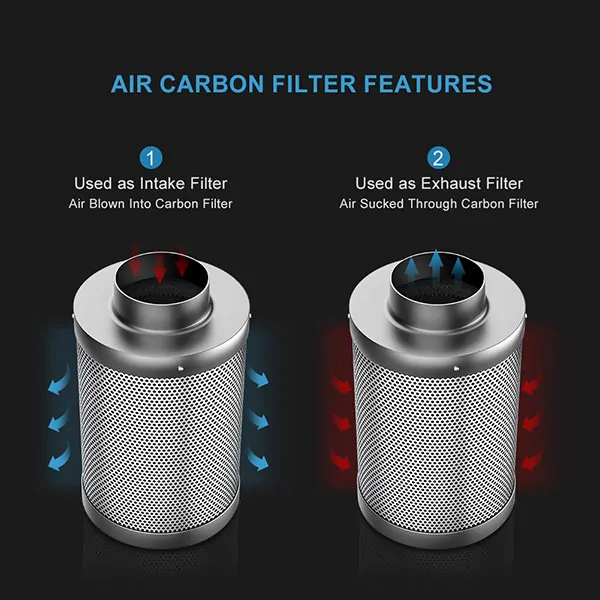
In mechanical ventilation, an activated carbon stage is installed either on the outdoor-air intake (protecting occupants from traffic fumes, industrial odors or wildfire-smoke gases) or on the exhaust path (treating odors before discharge):
Commercial HVAC & Urban Fresh-Air Intakes: Offices, apartments, clinics and schools located near busy roads or urban pollution benefit from a multi-stage duct air filter box combining a pre-filter, HEPA stage and activated carbon stage.
Commercial Kitchens & Food Preparation: Reduces cooking odors downstream of grease baffles and particulate filters (never expose raw activated carbon directly to airborne cooking grease, which blinds pores rapidly).
Print Shops, Laboratories & Light Workshops: Controls solvent and process-vapor odors (confirm whether specific chemical vapors require impregnated carbon media and local environmental compliance testing).
Bathrooms, Locker Rooms & Pet Facilities: Mitigates persistent organic odors in recirculated or closely sited exhaust outlets.
How to Size an Activated Carbon Filter & Match Fan Static Pressure
Selecting a carbon filter for ducted ventilation comes down to matching airflow, residence time and fan static pressure—not just picking the matching pipe diameter:
Confirm Operating Airflow (m³/h or CFM): Calculate required room air exchange first with our Calculadora de CFM de ventilación. Always choose a carbon filter or filter housing whose rated airflow equals or exceeds your fan’s operating airflow—forcing excess airflow through an undersized bed cuts contact time and spikes pressure drop.
Verify Carbon Mass & Bed Depth (Avoid Thin Carbon-Sprayed Pads): Thin foam sheets lightly dusted with carbon powder saturate quickly under continuous HVAC flow. As the U.S. EPA highlights, effective gas removal requires substantial activated carbon mass; pelletized or granular beds inside canisters or multi-stage filter boxes hold far more odor load than thin carbon-coated pre-filters.
Check Total Static Pressure Drop on the Fan Curve: Every pre-filter, HEPA stage and carbon bed adds resistance—and resistance climbs as the pre-filter loads with dust. Plot total duct + filter resistance against the fan curve (see our Static Pressure & Fan Curve Guide) and pair with a mixed-flow or centrifugal extractor en línea sized for the loaded condition.
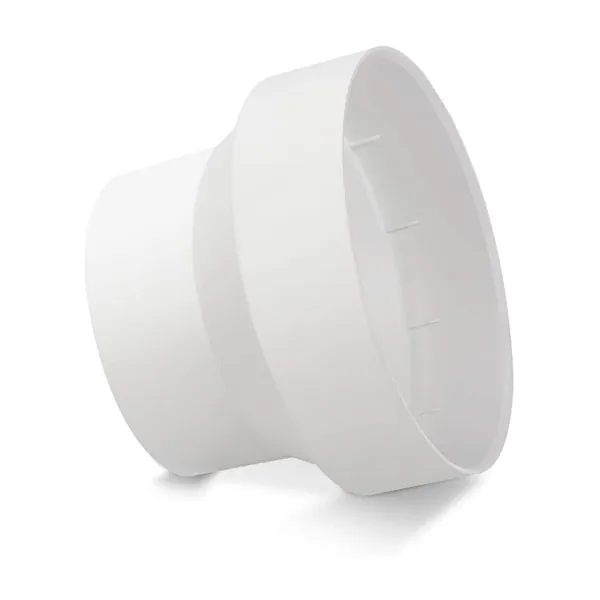
Seal All Connections & Match Duct Diameter: Match 100 mm, 150 mm, 200 mm or 250 mm duct flanges cleanly with clamps and foil tape or gaskets; even a small air gap around a filter frame lets untreated air bypass the carbon bed.
Lifespan & When to Replace an Activated Carbon Filter
There is no fixed universal lifespan for activated carbon because saturation speed depends directly on inlet odor/VOC concentration, airflow rate, carbon mass, relative humidity and daily run hours. Watch for four replacement triggers:
Odor Breakthrough: The most reliable field signal—when smells begin appearing downstream of the filter despite intact duct seals, the mass transfer zone has reached the outlet face.
Elevated Differential Pressure / Falling Airflow: If a particulate pre-filter clogs or dust coats the carbon media, static pressure climbs and delivered airflow drops.
High-Humidity Exposure: Water vapor competes with VOC molecules for adsorption sites inside micropores; sustained high relative humidity shortens effective gas-capture life and requires earlier replacement or upstream humidity control.
Scheduled Preventive Changeouts: Commercial buildings typically log filter installation dates and replace carbon stages on a regular preventive interval aligned with manufacturer datasheets and seasonal odor checks rather than waiting for tenant complaints.
Do not try to wash or sun-dry saturated carbon: Thermal reactivation of industrial activated carbon requires controlled high-temperature furnaces; rinsing carbon with water or vacuuming the outside will not release chemically or physically bound VOCs from internal micropores.
Lista de comprobación para el mantenimiento del filtro de carbón activo
Inspect and replace or clean the upstream particulate pre-filter routinely so lint, grease and dust never coat the carbon media.
Check filter-box door latches, frame gaskets and duct clamps for bypass leaks at every service visit.
Record baseline clean-filter airflow or pressure drop at commissioning so rising resistance is immediately visible.
Verify exhaust or supply humidity stays within the filter’s rated operating band to avoid premature moisture loading.
Log every replacement date and store spare carbon media sealed in airtight packaging (open carbon adsorbs ambient moisture and VOCs on the shelf).
Limitaciones de los filtros de carbón — Lea antes de comprar
Not Effective Against Every Gas: Standard untreated activated carbon adsorbs larger organic VOCs and odors well, but performs poorly on very light gases such as carbon monoxide (CO), carbon dioxide (CO₂) and some low-molecular-weight compounds like formaldehyde unless specially impregnated (U.S. EPA gas-phase air cleaner guidance). Never rely on a carbon filter for CO safety or oxygen supply.
Does Not Capture Dust or PM2.5 Alone: Always combine activated carbon with a particulate pre-filter and, where fine particles matter, a HEPA stage.
Does Not Replace Fresh-Air Ventilation: Recirculating room air through carbon lowers odors without removing occupant CO₂; pair filtration with controlled outdoor-air exchange (Cómo funciona la ventilación).
How KCVENTS Integrates Activated Carbon Filtration (Honest Product Scope)
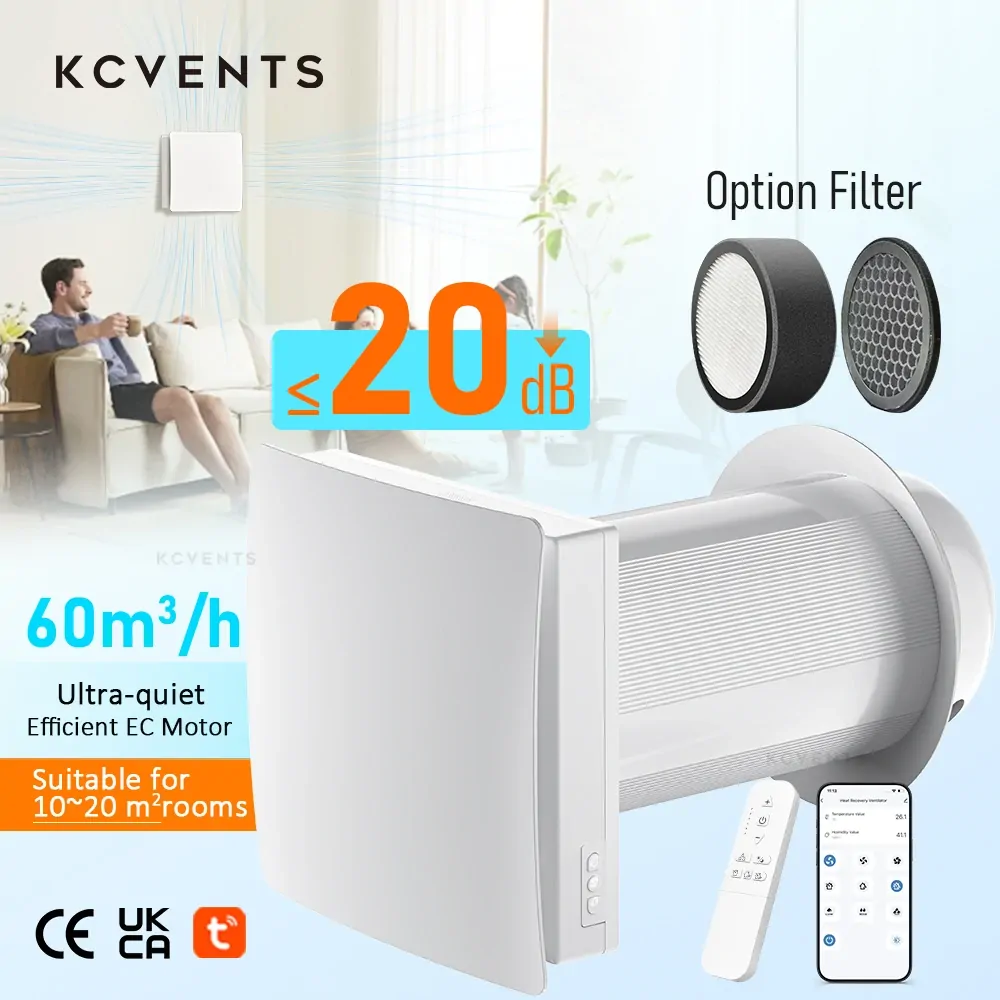
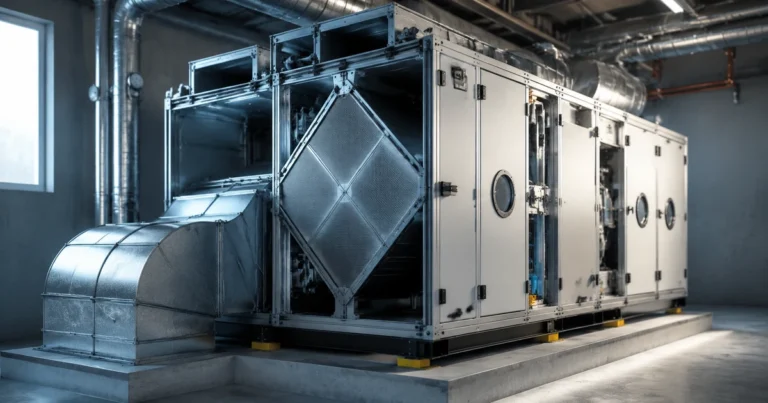
Transparency note: KCVENTS does not sell standalone activated carbon replacement cartridges or loose carbon canisters by themselves. Instead, as a B2B ventilation equipment manufacturer, we supply complete ducted filter boxes, filtered fresh-air ventilation units and heat recovery ventilators that integrate activated carbon alongside particulate filtration; wholesale and OEM/ODM options vary by model:
VT501: 20–60 m³/h, 15–30 dB, 250–500 mm wall; VT125: 20–60 m³/h, 24 m² listed area
Standard pre-filter (VT501: G3 + G4 standard) with optional HEPA and activated carbon filter set
Single-room retrofit bedrooms, apartments and urban offices needing heat recovery plus odor/PM2.5 reduction
Preguntas frecuentes
Q: How does an activated carbon filter remove odors and VOCs? A: Activated carbon has a vast internal pore structure that traps gas and odor molecules on its pore surfaces via physical adsorption as air flows through the bed (Activated carbon overview). Adequate carbon weight and contact time are essential for strong odor capture.
Q: Does an activated carbon filter remove dust, pollen or PM2.5? A: No. Carbon filters target gases and odors, while dust, pollen and PM2.5 require mechanical particulate media such as a pre-filter and HEPA filter. Combining both stages inside a sealed duct filter box handles particles and gases together.
Q: Can I wash and reuse a saturated activated carbon filter? A: No. Household washing, vacuuming or airing out does not release adsorbed VOC molecules from internal micropores and can damage the media. Replace the carbon stage once odor breakthrough occurs.
Q: Why did my carbon filter stop working early in a humid room? A: High relative humidity introduces abundant water vapor that competes with VOC molecules for active adsorption sites on the carbon surface. Controlling room humidity and keeping an upstream particulate pre-filter clean helps preserve carbon service life.
Q: Can an activated carbon filter remove carbon monoxide or natural gas leaks? A: No. Untreated activated carbon does not reliably capture carbon monoxide (CO) or methane/natural gas. Always use dedicated gas detectors, source repair and proper outdoor-air ventilation for combustion or fuel-gas safety.
Q: Does KCVENTS sell standalone replacement carbon canisters? A: No—KCVENTS manufactures complete ventilation equipment (including the GLX Caja de filtro HEPA para conducto, DPT-J filtered fresh-air unit, inline duct fans and HRV units with optional HEPA + carbon filter sets) for B2B wholesale and OEM/ODM projects.
Need a ducted filter box, filtered fresh-air unit or inline duct fan for your project? KCVENTS manufactures ventilation and filtration housings for wholesale, OEM and private-label buyers. Solicitar un presupuesto with your airflow, duct diameter and filtration stage requirements.
Actualizaciones del boletín
Introduce tu dirección de correo electrónico para suscribirte a nuestro boletín